Old Cowboy Bundle: Authentic Western Typography for Bold Designs
There's something unmistakably powerful about typography that carries history in its strokes. You know the feeling when you spot a vintage rodeo poster or an old saloon sign—the letters feel weathered, confident, and alive with character. That's exactly what the Old Cowboy Bundle delivers. This distressed Western typeface doesn't just spell out words; it tells a story before anyone reads a single letter.
Whether you're designing merchandise for a country music festival, crafting a brand identity for a rustic BBQ restaurant, or creating social media graphics for a line of leather goods, the right typeface can make or break your visual message. The Old Cowboy font family understands this deeply, offering six distinct styles that give you serious creative flexibility without sacrificing that authentic frontier spirit.
What Makes This Western Typeface Stand Out
Most "Western" fonts fall into one of two camps: either they're cartoonishly exaggerated or so subtle they could pass for any generic serif. Old Cowboy threads the needle beautifully. Its distressed edges and rugged letterforms feel genuinely worn, like they've been carved into wood or stamped onto leather. Yet the design remains clean enough for professional applications where readability actually matters.
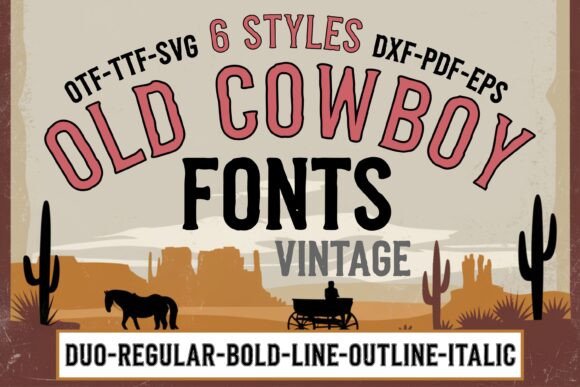
The real showstopper in this collection is the Old Cowboy Duo style. Here's how it works: uppercase letters appear in solid, bold weight while lowercase letters render as outlines that align perfectly beneath or alongside their uppercase counterparts. The result is a layered, two-tone effect that lets you introduce contrasting colors into your typography without any extra design work. Imagine a logo where "STEAKHOUSE" appears in deep burgundy with the supporting text outlined in gold—achieved with a single font, no complicated layering required.
Beyond the Duo style, you get five additional options: Regular for clean readability, Bold for maximum impact, Line for a sketched aesthetic, Outline for transparent letterforms, and Italic for directional energy. Each style ships in OTF, TTF, SVG, DXF, PDF, and EPS formats, which means compatibility with virtually everything—Adobe Creative Suite, Cricut Design Space, Silhouette Studio, Procreate, Canva, and countless other platforms.
Practical Applications Across Industries
Let's talk about where this font actually earns its keep. A typeface is only as valuable as the projects it serves, and Old Cowboy has surprising range for something with such a specific personality.
Brand Identity and Logo Design
For businesses rooted in Americana—craft breweries, ranch-to-table restaurants, outdoor adventure companies, vintage clothing brands—this font provides instant visual shorthand. A logo using Old Cowboy Bold immediately communicates authenticity and ruggedness. Pair it with a simple sans serif for body copy, and you've got a brand identity that feels cohesive and intentional.
Packaging and Product Design
Think about hot sauce labels, artisan jerky bags, small-batch whiskey bottles, or handmade soap packaging. Consumers browsing shelves make split-second decisions, and distinctive typography catches the eye before ingredient lists or price tags ever come into play. The distressed texture of this typeface adds tactile warmth to flat packaging designs, suggesting craftsmanship and tradition.
Merchandise and Apparel
T-shirt designers and print-on-demand entrepreneurs will find the SVG and DXF files particularly useful. These formats work seamlessly with cutting machines, making it straightforward to create iron-on vinyl designs, screen-printed graphics, or embroidered patches. The Duo style shines here—imagine a rodeo event tee where the event name layers bold and outlined letters in team colors.
Event Invitations and Print Materials
Wedding invitations for barn or ranch celebrations, rodeo event flyers, county fair posters, themed birthday parties—these are contexts where a generic script font feels lazy and a Western display font feels exactly right. The key is matching the font's intensity to your event's tone. Old Cowboy Italic works beautifully for elegant rustic invitations, while Bold handles high-energy event promotion.
Digital and Social Media
Instagram graphics, YouTube thumbnails, blog headers, website banners, email newsletter designs—digital creators constantly need fresh visual assets. A font like Old Cowboy helps your content stand out in crowded feeds because it's distinctive without being illegible. Use it for headlines and pull quotes while keeping body text in a clean sans serif like Montserrat or Open Sans.
Choosing the Right Style for Your Project
Not every style works for every application, and understanding the nuances saves you revision time. Here's practical guidance for selecting within the family:
- Old Cowboy Regular is your workhorse. It delivers the Western personality at a moderate intensity, making it suitable for longer headlines, subheadings, and contexts where you need character without overwhelming the composition.
- Old Cowboy Bold commands attention. Reserve it for primary headlines, logo marks, and situations where the text needs to dominate the visual hierarchy. It pairs exceptionally well with lighter-weight companion fonts.
- Old Cowboy Duo requires more design consideration but rewards the effort. It's ideal for hero text on posters, featured product names, or any scenario where you want a dynamic, colorful typographic element.
- Old Cowboy Line offers a hand-drawn, illustrative quality that works for storybook aesthetics, vintage map designs, or artisan product labeling where a softer touch is appropriate.
- Old Cowboy Outline creates visual breathing room. Use it when your background is busy or textured and you need text that won't compete with imagery. It also works beautifully as a secondary layer beneath Bold text for a dimensional effect.
- Old Cowboy Italic introduces motion and dynamism. It's perfect for taglines, directional text, or any context where you want the typography to feel active rather than static.
Font Pairing and Readability Considerations
A display font like Old Cowboy works best in partnership with complementary typefaces. Because it carries so much personality, pairing it with something neutral prevents visual chaos. Strong companions include:
- Sans serif fonts like Lato, Roboto, or Futura for clean contrast
- Simple serif fonts like Lora or Merriweather for a slightly more traditional feel
- Handwritten or script fonts for layered, artisan-style compositions—though use this combination sparingly to avoid clutter
Readability deserves honest attention. This is a display typeface, meaning it's engineered for impact at larger sizes rather than extended reading at small scales. Use it for headlines, titles, logos, and short phrases. For body copy, paragraphs, or fine print, switch to a highly legible text font. This isn't a limitation—it's how display fonts are designed to function. The best designers know when to let a bold typeface lead and when to let it rest.
Before finalizing any design, test your typography at the actual size it will appear. A headline that looks stunning on your 27-inch monitor might lose its distressed details when printed at three inches wide. Conversely, a font that seems overwhelming on screen might feel perfectly proportioned on a six-foot event banner.
Licensing and File Formats Worth Understanding
When investing in a premium font like the Old Cowboy Bundle, understanding what you're getting matters. The inclusion of OTF and TTF files covers standard desktop installation for Mac and Windows. SVG and DXF files are specifically valuable for crafters and designers working with Cricut, Silhouette, and similar cutting machines—these formats preserve the font's vector quality at any scale. PDF and EPS files serve print professionals who need maximum compatibility with commercial printing workflows.
Always review the licensing terms included with your purchase. Most commercial font licenses cover a specific range of uses—logos, merchandise, digital products, print materials—but may have restrictions on embedding in apps or reselling the font files themselves. Understanding these boundaries upfront protects your business and respects the type designer's work.
Bringing It All Together
The Old Cowboy Bundle isn't trying to be everything to everyone, and that's precisely its strength. It occupies a specific creative lane—Western, vintage, rugged, Americana—and executes that vision with genuine craftsmanship across six versatile styles. For designers, entrepreneurs, and creators whose projects live in that world, it's the kind of design asset that earns its place in your permanent toolkit.
The real value emerges when you stop thinking of it as "a cowboy font" and start seeing it as a communication tool. Every design choice you make—from the style you select to the colors you pair it with to the companion fonts you choose—shapes how your audience perceives your message. A well-chosen typeface doesn't just look good. It builds trust, creates emotional resonance, and makes your brand or project feel intentional and professional.
Start by experimenting with the Regular and Bold styles in a current project. Get comfortable with how the distressed texture renders at different sizes. Then explore the Duo style when you're ready for something more ambitious. Typography rewards experimentation, and a font family with this much built-in variety gives you plenty of room to play.